Beaujolais Half Day Wine Tasting Tour
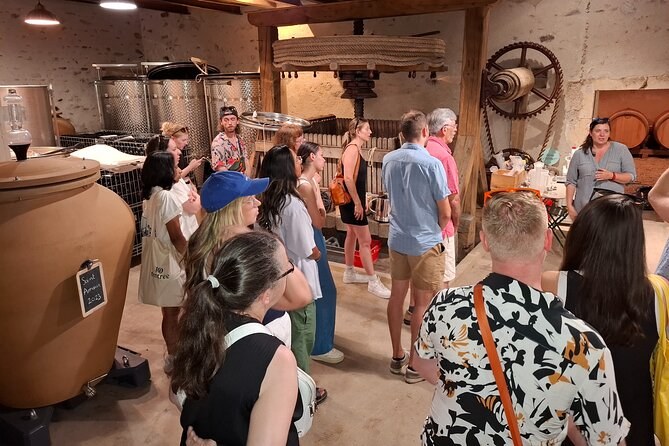
A 9 am start from Place Bellecour: an hour on Château de Pizay's sensory wine circuit, the road through Morgon, Fleurie and Juliénas, then an hour with a family winemaker.
From $114 per person
Check AvailabilityThe Beaujolais wine route runs 55 km from the edge of Lyon to the south of Burgundy. Its south is the golden-stone country of the Pierres Dorées, and its north holds the ten crus. If the south is your half, a golden stones beaujolais wine tour reaches it in about four hours.
The vineyards stretch 55 km north to south. The foothills of the Massif Central border them to the west, and the Saône plain to the east. From Lyon, the first vines are less than 30 minutes away by car.
About 13,500 hectares of vines are declared under the region's twelve appellations. Inter Beaujolais, the wine council, has mapped more than 300 soils across them, in a study run from 2009 to 2018. That is why two villages a few kilometres apart pour such different wines.
The twelve fall into three levels. You will meet all three on a full day, and the label tells you which one is in your glass.
The table sets out seven of the twelve, with their communes, altitude and soils.
| Appellation | Communes | Altitude | Main soils |
|---|---|---|---|
| Beaujolais | 72, mainly the south | 360 m | pink granite, blue stone, limestone, clay |
| Beaujolais-Villages | 38, in the north | 332 m (vines 200-500 m) | gneiss, blue stone, sandstone, shale, granite |
| Brouilly | Odenas, Quincié, Saint-Lager, Saint-Étienne-la-Varenne, Cercié, Charentay | 290 m | pink granite 46%, blue stone, limestone, marl |
| Côte de Brouilly | Odenas, Quincié, Cercié, Saint-Lager | 300 m | blue stone 40%, granite 24% |
| Morgon | Villié-Morgon | 310 m | granite 52%, blue stone 37% |
| Fleurie | Fleurie | 340 m | pink granite 90% |
| Moulin-à-Vent | Romanèche-Thorins and Chénas | 255 m | granite, limestone, marl, sandstone |
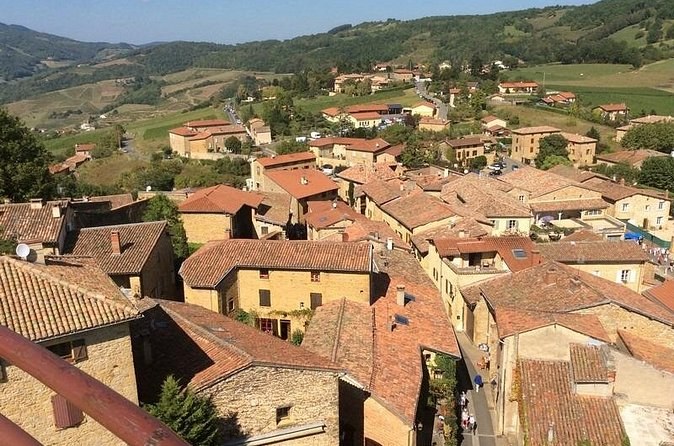
The south is clay and chalky soil on rolling hills, and villages built of ochre limestone. It makes most of the regional Beaujolais, and it has the region's whites: over 300 hectares around Liergues, Le Bois-d'Oingt and Bully.
Oingt is its best-known village. The Golden Stones half days pour at a winery near it and at a second one in Montmelas-Saint-Sorlin, in the Beaujolais-Villages appellation. You drive through the villages between the two, and the whole day takes about four hours.
The north is sandier soil, much of it granite. Here the villages give their own names to the wine. Here are five of them, with the tours that reach each.
Fleurie
Soil: pink granite, 90%
On: most crus days
Iris, violet and peach on the nose, from sandy granite soil. La Madone hill rises to 425 m above the vines.
Morgon
Village: Villié-Morgon
On: the wine merchant's day
Sour cherry, violet and kirsch. The Côte du Py, on decomposed shale, is its best-known slope.
Moulin-à-Vent
Communes: Romanèche-Thorins and Chénas
Tour: the crus full day stops in Romanèche-Thorins
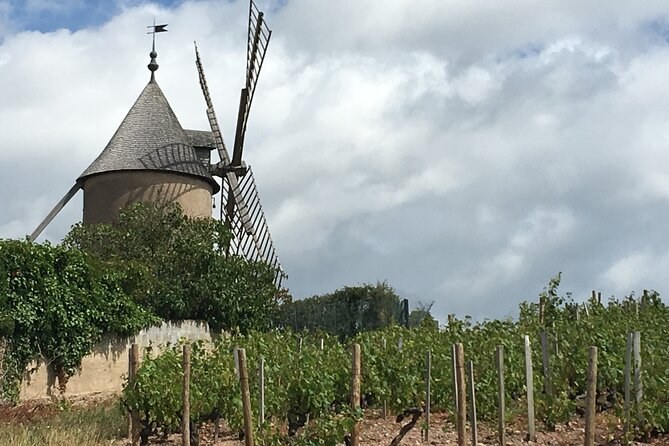
Violet and cherry when young; iris, spice and ripe fruit after a few years. The windmill stands at 278 m.
Côte de Brouilly
Where: the slopes of Mont Brouilly
On: a private day
Pepper, small black fruit and a mineral note. The chapel on the summit dates from 1854.
Brouilly
Where: the foot of Mont Brouilly
Appellation: since 1938
The southernmost cru: plum, strawberry and raspberry, for drinking young.
The other five are Chénas, Chiroubles, Juliénas, Régnié and Saint-Amour. The afternoon tour pours in a château cellar in Chénas, and the vintage Land Rover day takes you to Juliénas, Saint-Amour-Bellevue and Régnié-Durette. The wine merchant's day picnics on the Chiroubles hillside.
Gamay covers nearly all of the Beaujolais, and it has grown here since the early 17th century. Half of the world's 30,000 hectares of gamay are in the region. It is a natural cross of pinot noir and gouais blanc.
Granite seems to be its soil of choice, and the crus of the north grow on it. In your glass it gives raspberry, wild strawberry, blackberry and black cherry, sometimes pepper or flowers. The wines are low in alcohol, and many are ready to drink young.
Reds make 95% of the region's wine, so you will taste mostly gamay. Beaujolais rosé has been an appellation since 1937, and the Beaujolais-Villages appellation makes rosé as well as red.
If you want a white, go south. The half day around Oingt and Le Bois-d'Oingt opens with a white and a red, and its family estate pours a white alongside its reds.
Beaujolais Nouveau is the young wine of the year's harvest, released on the third Thursday of November. In 2026 that is Thursday 19 November. It is gamay at its most cheerful and fruity, the style the wine council calls festive.
You do not need a special tour for it. On a late-November day, ask your guide whether the estates are pouring the new wine next to the older crus.
Choose your half first, then your village. This table tells you where each day pours.
| The day | Half | Where you taste |
|---|---|---|
| The Golden Stones half days | South | A Pierres Dorées winery near Oingt, and one in Montmelas-Saint-Sorlin |
| The south half day with a white | South | Around Oingt, then Le Bois-d'Oingt |
| The Pérouges private day | South | A family winery around Oingt |
| The two wine route half days | North | Château de Pizay, the road past the crus, a family winery |
| The crus half day with tastings | North | Two estates in two different crus |
| The afternoon crus tour | North | Cercié, then a château cellar in Chénas |
| The crus full day | North | Around Fleurie, then Romanèche-Thorins |
| The full day through both halves | Both | Near Oingt, then Fleurie |
| The vintage Land Rover day | North | Fleurie, Saint-Amour-Bellevue, Chénas, Juliénas, Régnié-Durette |
| The vintage Defender day | North | Fleurie and Juliénas |
| The private winter day | North | Romanèche-Thorins and Fleurie |
| The Signature day | North | Two wineries, past Villié-Morgon and Chiroubles |
| The wine merchant's day | North | Fleurie, Villié-Morgon, the Chiroubles hillside |
| The private day with up to three wineries | North | Côte de Brouilly and Fleurie |
For the south, the beaujolais half day wine tasting tour is the usual choice: four hours and back in Lyon for lunch. For the crus, a full day gives you two estates and a restaurant lunch, and the private beaujolais tours reach further north, to Juliénas and Saint-Amour.
The appellations, soils, altitudes, grapes, colours and the Nouveau date come from Inter Beaujolais, the Beaujolais wine council. The tasting notes are theirs too. Every village a tour visits comes from that tour's booking page.
A 9 am start from Place Bellecour: an hour on Château de Pizay's sensory wine circuit, the road through Morgon, Fleurie and Juliénas, then an hour with a family winemaker.
From $114 per person
Check Availability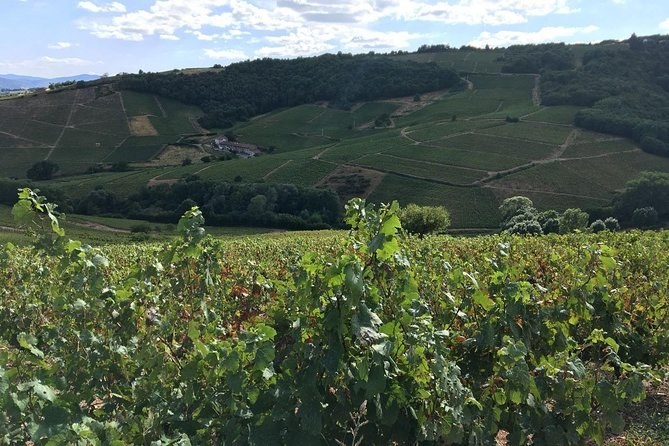
A shared full day from Place Bellecour at 9 am: about three hours at an estate around Fleurie, lunch at a village restaurant at your own cost, then Romanèche-Thorins.
From $161 per person
Check Availability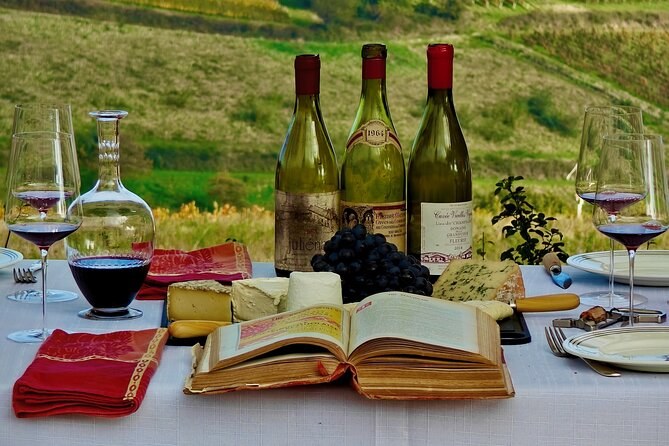
A wine merchant's private day: Fleurie and Villié-Morgon in the morning, the Mont Brouilly viewpoint, and a picnic that pours gamay from the 1960s to today, 15 to 20 wines in all.
From $1,158 per person
Check AvailabilityNext: see the tower and the viewpoints on things to do in the Beaujolais, check the month on the Beaujolais weather page, or compare every day on Beaujolais Tours.